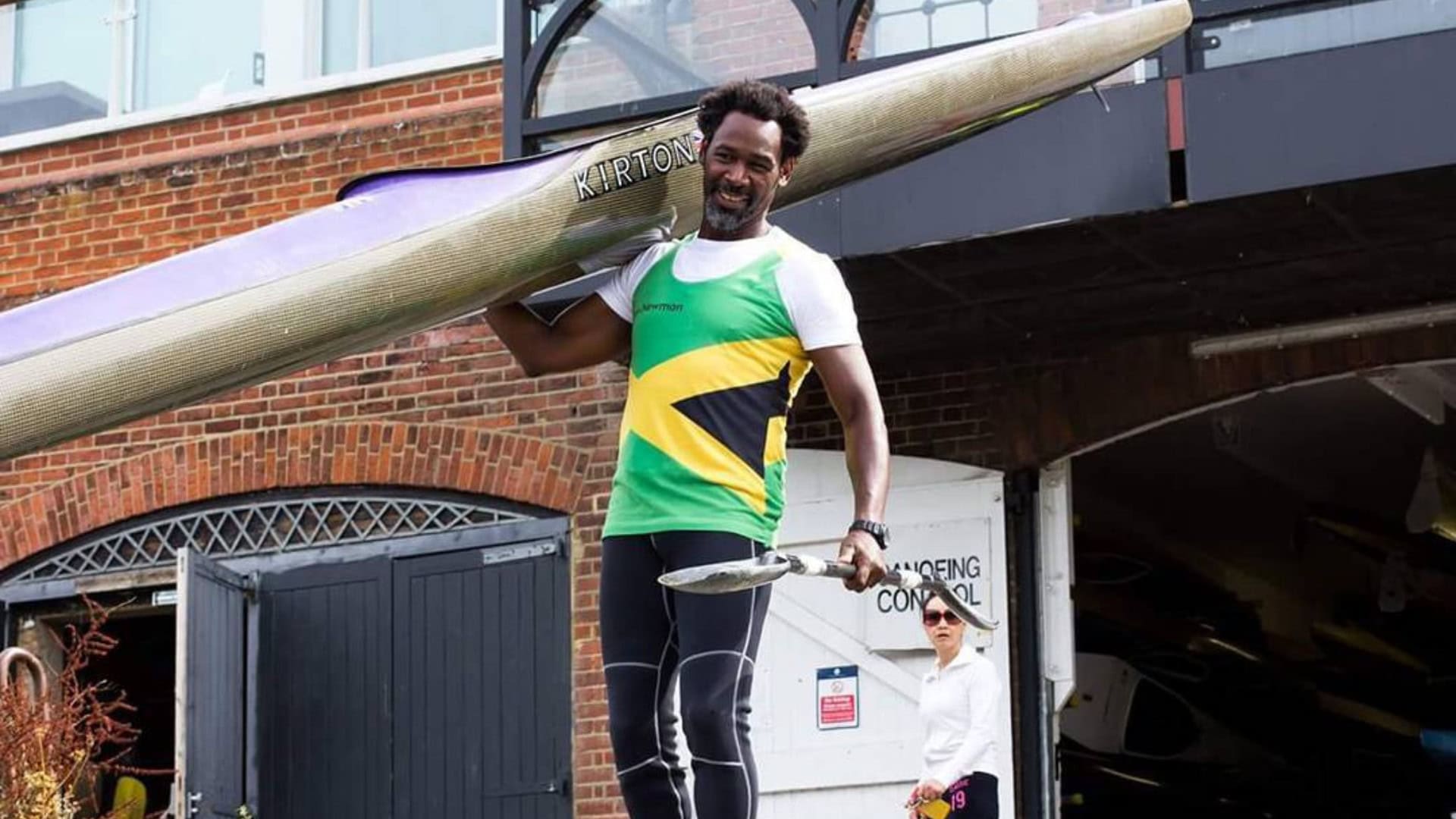
October marks the annual celebration of Black History Month, and as part of our #WePaddleTogether commitments to celebrate role models from under-represented groups, and listen to diverse, intersectional voices, we are pleased to share the insights and stories of Black paddlers from across the paddling community. We caught up with Tony for his reflections this Black History Month.
In paddling circles, Tony Greyson-Newman is known as “The Jamaican Kayaksman”, as he made history as the first person to represent Jamaica internationally in sprint kayaking. Tony had been active in a number of sports, including swimming and martial arts, but took up sprint kayaking in his forties.
Tony lives in Portsmouth now, moving from London, and after the success and excitement of 2012 London Olympic Games, was looking for a new sport after winding down his involvement in martial arts.
“I was literally just looking at Olympic sports, going down the list, starting at athletics and stopped at canoeing. I thought ‘well let’s give this a go then’, because my children had enjoyed it.”

He soon found himself out on the water at Westminster Boating Base, Pimlico, on cold Sunday mornings.
“It was just recreational paddling sessions and we used to paddle up to Tower Bridge and back.”
But with his competitive spirit, Tony decided he wanted to race, and joined Richmond Canoe Club, as one of only two Black people at the club.
And the rest, as they say, is history. From beginning his competitive career with Richmond Canoe Club, Tony then went on to race for Jamaica in international competitions such as the Liffey Descent (Ireland, 2014), the Sella Descent (Spain, 2015), and the Pan American Games (2019).
He has since returned to Kingston, Jamaica to share his skills, knowledge and experience with young people to hopefully inspire a new generation of Jamaican paddling talent. Tony, being a Masters Kayaker himself, would like to see older participants too. Tony told Team JA:
“What was special about competing for Jamaica, was not just the opportunity to represent, but also the chance to put Jamaica on the map and pave the way for generations to come, that are also interested in the sport. I feel it’s my responsibility to inspire and encourage those on the island and in the diaspora to take part.”
His experiences outside of competitive kayaking has also been impressive – in one of his challenges, he kayaked 14 rivers across Jamaica in 7 days to showcase the vast waterways network that can be paddled across the country and raise money for premises and equipment for Kingston Aquatic Sports Centre, a potential venue for kayaking and other paddlesports in Jamaica.
Words by Tony
You are widely known as the first sprint kayaker to represent Jamaica, and over the last couple of years, we’ve caught up with Solomon Maragh, who is now Jamaica’s first canoe slalom athlete. What does that represent to you, and have you been following Solomon’s journey?
Solomon competing for Jamaica is awesome! For me, it’s always been about the journey, not the destination. As a competitor you want to be amongst the best, and while representing Jamaica at an Olympics as a sprint kayaker didn’t happen for me, reflecting on the journey I’ve been on, it has been amazing.
I saw canoe slalom for the first time at Lee Valley White Water Centre about nine years ago, and for a minute I thought, ‘Wait, have I picked the wrong type of paddling?!’ It was such a great venue, the sun was shining, and it was amazing to watch. Getting to see Solomon compete for Jamaica at the same venue this year, I thought to myself, ‘This is what it’s all about’. I feel pride for him and his achievements, and I see the passion and excitement in him to be the best.
When I was competing, Jamaica didn’t have any representation in paddling, but as a young athlete, he really gets the opportunity to be fully competitive in the sport. I was always overwhelmed by the warmth and reception I received from other athletes when paddling, whether for Richmond Canoe Club, Ealing CC, Southampton CC, where I paddle now, or Jamaica. Solomon tells me he receives the same warmth and excitement, and that’s very encouraging for us both.

Can you tell us a bit more about your experiences as a Black paddler? What have your highlights been?
I discovered paddling later in life, which is strange at times – although I’m in my fifties, I am really “young” in the sport, compared to other competitors my age who have been paddling for decades more. As a child I couldn’t swim, my parents also didn’t swim, so water sports and paddling didn’t seem like activities for me, even though I had the opportunity to do them at school.
I learnt to swim in my thirties, when my children started to learn. When I was growing up, you heard the stereotype that “Black people can’t make good swimmers because we have dense bones”, which you hear much less now, but was really prevalent at the time.
I was always overwhelmed by the warmth and reception I’d receive from other athletes when paddling, whether for Richmond or Jamaica. Solomon tells me he receives the same warmth and excitement, and that’s very encouraging for us both.
One of the greatest highlights of my career was competing at the Pan American Games. That was basically my Olympics – they had a full-blown athletes village and so much excitement around the competition, it was like nothing I’d ever experienced. It was also great to see other Black kayaking athletes from Argentina, Trinidad and Tobago, Dominican Republic, Belize and other countries in the region.
What would you like to share with people wanting to make paddling more inclusive and welcoming of Black communities?
There’s a bigger picture and conversation around representation, and the reasons why Black people aren’t well represented in paddling – it can be about access, opportunity and experiences, all sorts of things. I think two things are important for the paddling community to know. The first is that role models and visual representation are so key. It’s important for everyone to see Black people active in the paddling community, and in images and on social media. That says to everyone, hey, Black people can paddle, this is somewhere they belong.
The second is about the need to engage with communities. Dean Maragh, Solomon’s dad, shared this analogy with me: If you have a restaurant, and you ask, how do I get Black people to come to my restaurant, what do you do? You change the menu so they want to come and eat there, and in order to change the menu, you need to know what Black communities like. You can’t decide that they want fish and chips without asking. So you need to engage with the community to understand their needs better.