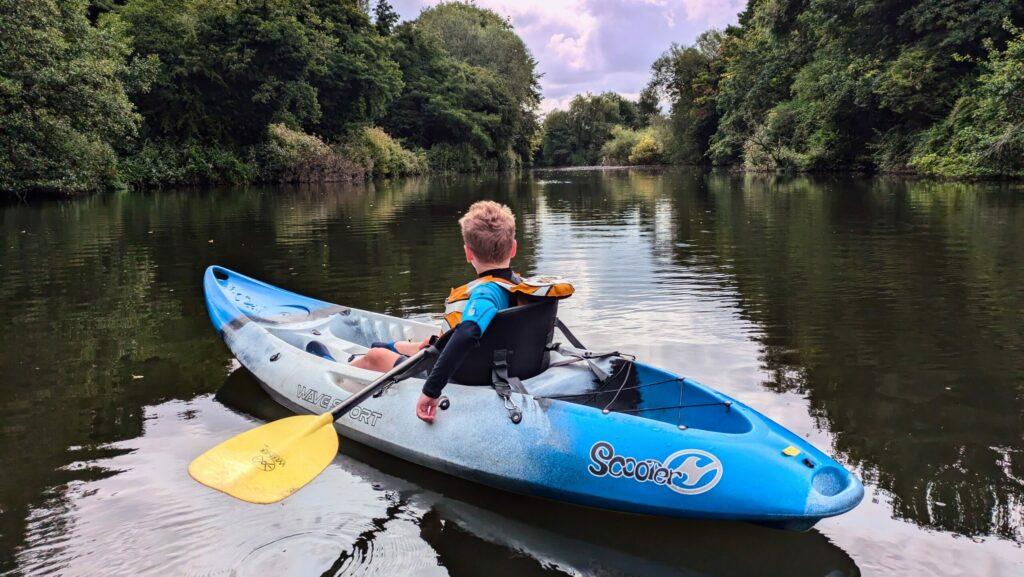
Ben Seal, Head of Access & Environment at Paddle UK, explains how by increasing access to our rivers it could also make them cleaner.
At a time when concern about the cleanliness of our rivers is of serious concern to all blue spaces users, it feels almost counter intuitive to argue that expanding our access freedom will aid the drive towards cleaner waters.
But the simple facts show that when communities have good access to rivers, they are more likely to become involved in protecting them, leading to a cleaner, healthier environment.
Countless initiatives, ranging from river clean ups, like our Big Paddle Clean Up, to citizen science, prove that when people have the freedom to connect with blue space, then they are more inclined to protect it.
Environmental Stewardship and Awareness
People who regularly walk, fish, swim, row or paddle along rivers are far more likely to notice and report pollution, litter, or other environmental issues. Before the fitting of EDM monitors to Combined Sewage Overflows, it was paddlers and anglers who were regularly notifying water companies when their assets were spewing sewage into the river.
It is often these same people who are voluntarily motivated to initiate community-led clean-up efforts, take part in ‘CSO safari’s, raise funds for and manage habitat restoration projects or tackle invasive non-native species.
Grassroots actions like these are utterly essential for maintaining and improving water quality, as they often address problems that would otherwise go unnoticed by regulatory authorities.
But you have to be there, to notice.
Citizen Science and Monitoring
The number of citizen science initiatives now collecting data on water quality in our rivers is bewildering.
New techniques and technologies are rapidly coming online to help communities collect and interpret more accurate, more consistent and more real time data than ever before.
It is demand that has driven this rapid innovation in water quality monitoring.
Demand from the industry yes, but also demand from the millions of amateur citizen scientists across the country, hungry to understand what is happening in their river, on their doorstep.
These countless citizen scientists are providing valuable information that is rapidly expanding the understanding the water sector and government has about our waterways.
They are identifying pollution sources more quickly, allowing for faster intervention and remediation efforts.
But to care, it helps to be there…?

Increased Accountability
The number of people paddling and swimming in rivers has grown massively in recent years.
It is little wonder then, that with more people accessing rivers (whether they have a ‘legal right’ or not), public pressure on water companies and agricultural operations has increased.
The scrutiny of our water sector that we now see in the media every single day, was not stimulated by the regulator, nor the Government. It has been driven by public outcry. By people who care.
The actions (subsequently) taken by the water sector and the Government have come as a result of pressure from people who cared to speak out.
Organisations like Surfers Against Sewage who have been championing these issues for years.
It is these people, who are desperate to avoid getting sick doing what they love and desperate to prevent the further degradation of our precious natural habitats who have forced greater scrutiny of a water sector which had been allowed to degrade our waters for decades.
But to care, people needed to be aware.
Sharing is caring
The recent unity shown by national governing bodies campaigning against water pollution demonstrates emphatically that we are all stronger together to tackle a common threat to our shared environment.
Finding consensus on legal access rights may continue to prove challenging for months if not years to come, however what is clear is that as a community of river users, we are more united than we have ever been.
Where our focus must reside, is on securing a healthy environment that we can all enjoy.
Ultimately, expanding our rights to access inland waterways is not just about increasing the places people can explore for fun and adventure.
Of course it will undoubtedly create more opportunities for people to be active in nature, whether it be in, on or alongside water.
Recent history shows that where people are given the freedom to share and care for their local blue spaces, society will be in a far stronger position to safeguard river health in future.
We must not fall into the same trap again.
We must not allow our rivers to become so polluted.
Therefore, allowing people to share our waters, will foster a culture of environmental responsibility and support active stewardship of our waterways by future generations.