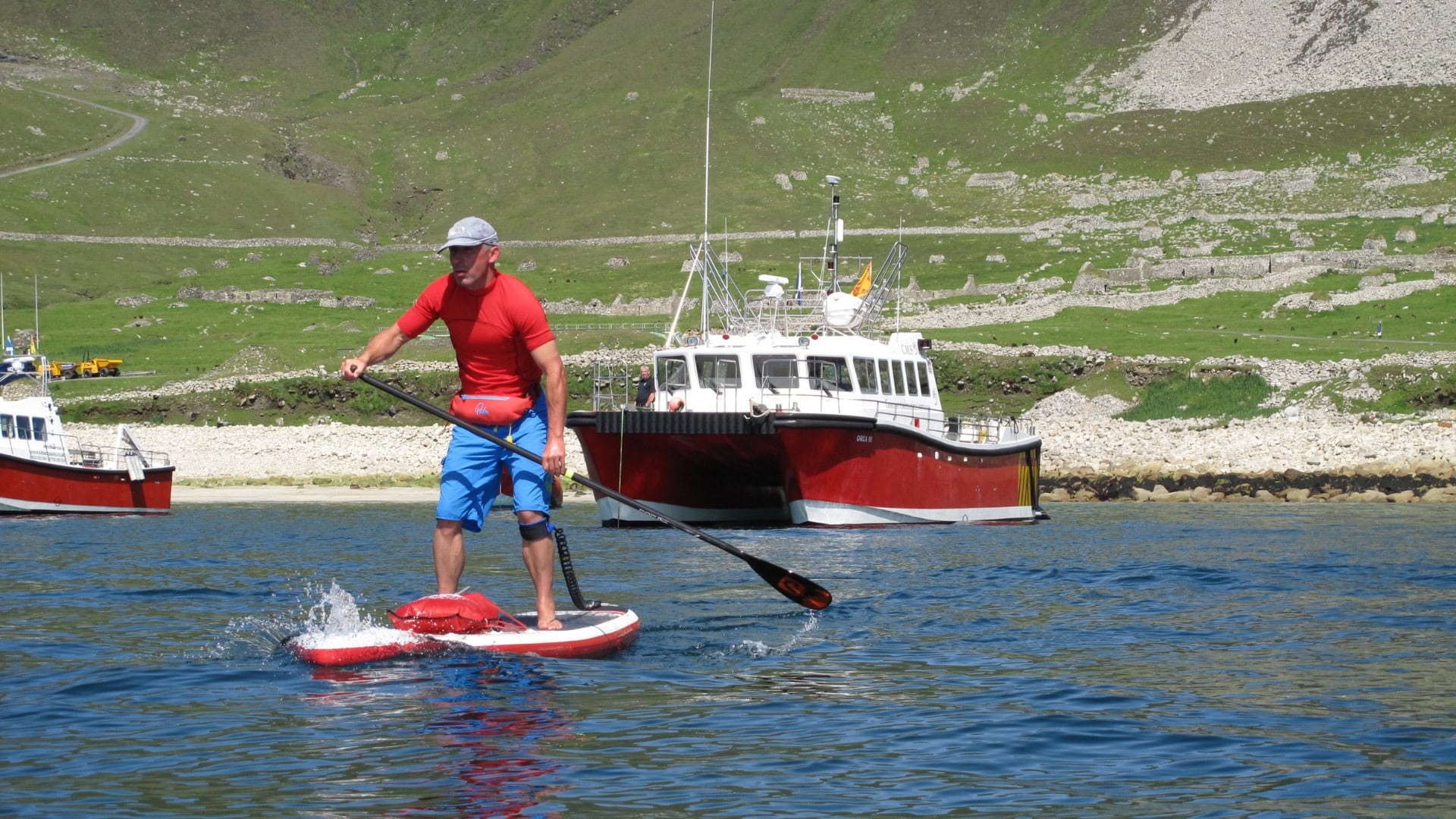
Meet Dean Dunbar, a paddler from Scotland who isn’t letting his sight loss stop him from some extreme adventures.
At the age of 9, whilst living in the North East of England, Dean’s sight unexpectedly dropped. At that point he was registered as “partially sighted”. In 1996, whilst living in Devon, Dean’s sight got even worse and became “registered blind”.
Two years later Dean did a charity tandem skydive which changed his life. The adrenaline rush was so intense, that he had to get it again. He is now a confirmed “adrenaline junkie”.
You’ll often find Dean out on the water enjoying adventures and taking on new challenges. We caught up with him to find out more about his experiences paddling with sight loss

Can you tell us a little bit more about your paddling experience?
I had paddled, (canoe & kayak) in my late teens, often as one day out experiences. Then when my wife, Rhona, and I moved to Scotland in 2002, we bought a kayak. We had several boats over the next few years, paddling mostly on lochs. In 2014, a friend suggested I try SUP. I bought my first board in April and six months later we spent three days paddling the 92km Caledonian Canal. From there I was hooked, and went on to spend the next five years taking on all sorts of challenges, sometimes on my own and other times with friends. In 2018 I injured my foot during the 11 City non-stop race, so now I do prone paddleboarding, which I absolutely love.
What has helped or supported you the most to continue paddling?
Being blind, it isn’t always safe for me to take on some of my bigger challenges on my own, so having Rhona and/or friends along as sighted guides has made my bigger adventures possible. I have also started entering races, and the support I get from the organisers is invaluable. When I started doing extreme sports back in 1998 I would regularly get knocked back as soon as I mentioned the “blind” thing. GBSUP, SSF, and other event organisers in the UK have always been very positive and inclusive, for which I am very grateful.
Trust in your guide is a major factor, and it can take longer to build that trust with some guides than others. I have a really good friend called Patrick Winterton, who has been my guide on several adventures, including the following one. In 2017 I paddleboarded out to St Kilda, (the most remote part of the British Isles – 70km west of the Outer Hebrides.) The first day was a very lumpy 15km out to an island called Haskier where we were to spend the night. (“Island” is quite a grandiose title, “pile of rocks” may be more accurate.) Anyway, on arrival, Patrick told me that the only way to get onto the island, was to leap up from my SUP and grab a narrow ledge, (that I couldn’t see), and then pull myself up onto it. This is where “trust” comes into play. I’d done enough in the past to trust him, so standing on my SUP, I leapt forward at the cliff. As my hands hit the cliff face, the wall was flat, and I began to slide down it. It was at this point, I started to wonder if my trust was misplaced. But just as I’d come to terms with the fact I was about to take an early bath, my fingertips felt the ledge. I grabbed onto it, and was then able to pull myself up. As I said, “trust” is a major factor!

What should people consider when supporting blind or visually impaired paddlers on the water?
When I’m paddling with friends, I’m not that fussed about people trying to describe the trees on the hill, or the old castle. For me, I like it when they tell me about the state of the water, if it’s lumpy, if there are boat wakes, that sort of thing. Also, for guidance purposes, I work best with clock face directions. Instead of saying “go left a little bit”, I’d rather have “go to 11 o’clock” etc.
I have one friend who has used my blindness to our advantage when we were in a kayak race. He would tell me that a boat was catching us up and I needed to pick it up a gear. I later found out that there was no boat catching us up. But he knew what motivated me.
Dean is always looking for new adventures and he shares them over on his website Extreme Dreams. From paddlebaording and kayaking trips to skydiving, zorbing and open water swimming. If you’d like to follow his journey head over and explore his website here.